The Jolly Roger
Separating Skull and Crossbones Fact from Fiction
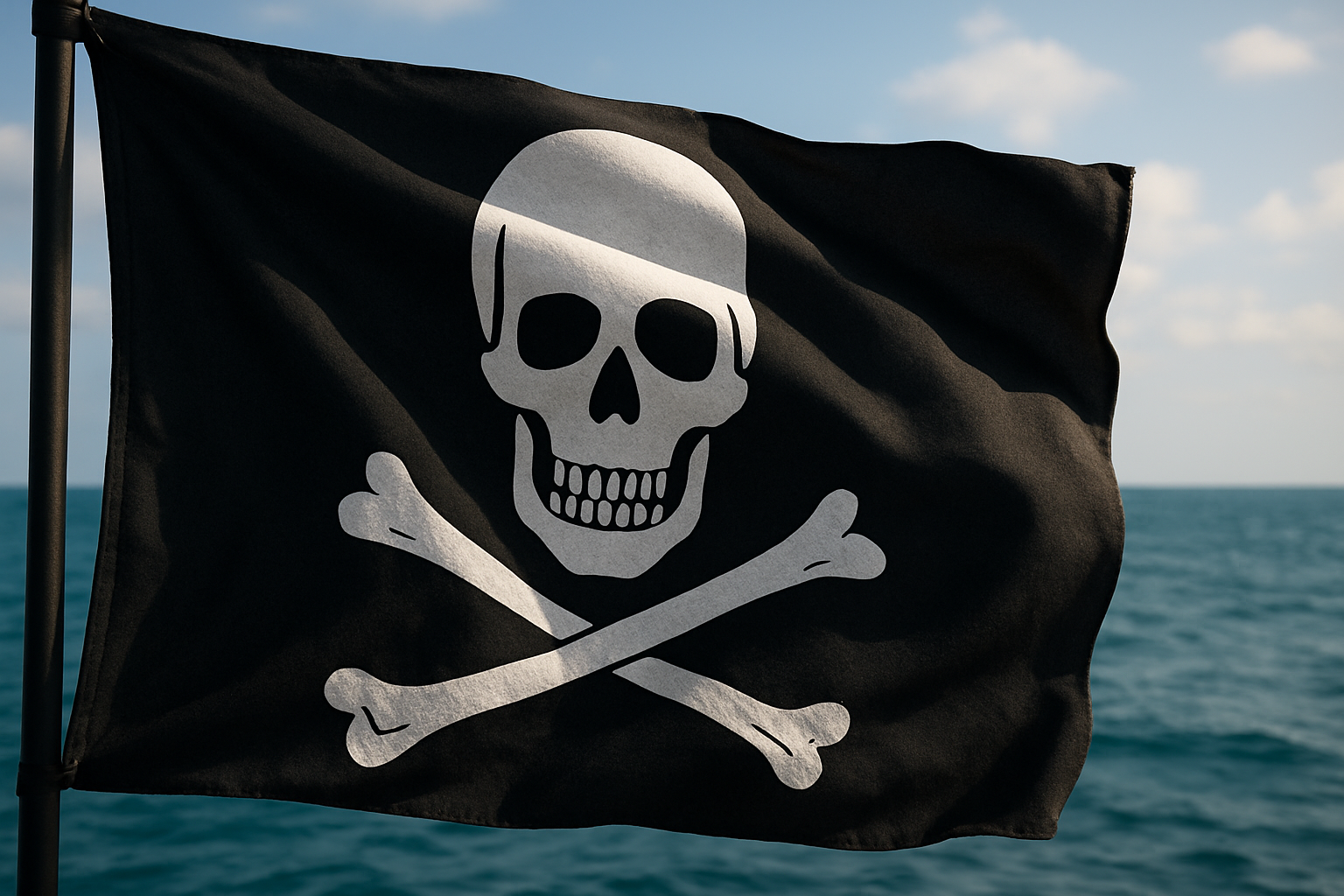
The black flag with white skull and crossbones has become the universal symbol of piracy, instantly recognizable from countless movies, books, and Halloween costumes. Yet like many aspects of pirate history, the reality of the "Jolly Roger" proves far more complex and varied than popular culture suggests. The term itself didn't appear in print until decades after the Golden Age of Piracy ended, and surviving historical evidence reveals that most pirate flags bore little resemblance to the standardized skull-and-crossbones design that dominates modern imagination.
The true history of pirate flags encompasses a diverse array of symbols, colors, and personal designs that served specific tactical and psychological purposes in maritime warfare. Rather than flying identical flags, successful pirate captains developed distinctive banners that became their calling cards—some featuring skeletons, others showing hourglasses, bleeding hearts, or raised swords. Understanding this historical reality reveals how pirates used visual symbolism as sophisticated psychological warfare while the modern "Jolly Roger" emerged from centuries of literary and cultural evolution.
The Term "Jolly Roger": A Historical Mystery
The phrase "Jolly Roger" appeared in print near the end of the Golden Age (1723-1724). The earliest known citation appears in the Boston News-Letter of 17 October 1723, followed by Captain Charles Johnson's 1724 "A General History of the Pyrates." Even then, Johnson used it sparingly and without explanation, suggesting his readers already understood the reference. The etymology remains disputed among historians, with theories ranging from "joli rouge" (pretty red) referring to red flags, to corruptions of "Ali Raja" (an Indian Ocean pirate title), to simple English slang for the devil ("Old Roger").
Contemporary pirates themselves rarely used the term in surviving documents. Trial records, ship logs, and firsthand accounts from the Golden Age typically describe pirate flags as "black flags," "bloody flags," or "the flag of defiance" without employing any standardized terminology. The romantic notion of pirates universally calling their banners "Jolly Rogers" appears to be largely a post-Golden Age invention, popularized by later authors who sought dramatic terminology for their maritime adventures.
Captain Bartholomew Roberts' crew did use the term according to Johnson's account, with one crew member reportedly declaring they would "fight under the Jolly Roger" during their final battle in 1722. However, this remains one of the few documented uses of the phrase by actual pirates during the period, suggesting it may have been specific slang rather than universal pirate terminology.
The absence of the term in contemporary sources doesn't diminish the historical reality of pirate flags—it simply reveals how modern language has shaped our understanding of historical practices. Pirates certainly flew distinctive banners, but they likely thought of them in more practical terms as signals, warnings, or personal emblems rather than romantic symbols deserving special names.
Historical Pirate Flags: Diversity Over Uniformity
Archaeological and documentary evidence reveals that historical pirate flags displayed remarkable variety in design, color, and symbolism, challenging the notion that pirates flew standardized skull-and-crossbones banners. No flag can be proven 100% pirate; two textiles in the National Maritime Museum and Musée de la Marine are 'attributed' with disputed provenance, and these show diverse designs that bear little resemblance to the modern stereotypical Jolly Roger.
The familiar skeleton-and-heart design attributed to Blackbeard is a 20th-century attribution; no contemporary source describes Blackbeard's flag. The skeleton holding an hourglass and spear pointed at a bleeding heart appears in 1723-24 accounts describing Edward Low or an anonymous West Indies pirate—a complex composition that conveyed specific messages about time running out and mortal consequences. Bartholomew Roberts used multiple flag designs documented by eyewitness Thomas Sutton and contemporary engravings, including one showing himself standing on two skulls labeled "ABH" (A Barbadian's Head) and "AMH" (A Martiniquian's Head), reflecting his personal vendetta against those colonial governments that had opposed him.
Calico Jack Rackham's flag displayed a skull with crossed cutlasses rather than bones, first illustrated in a c. 1720 broadsheet; authenticity is probable but not certain. Some pirates employed red flags (the "bloody flag") to signal no quarter would be given, while others used entirely different color schemes including white flags with red or black symbols. The variety extended to non-skull imagery: Captain Christopher Condent flew a flag featuring three skulls and crossbones, while other pirates used hourglasses, skeletons, devils, or personal symbols.
The standardized skull-and-crossbones design that dominates modern pirate imagery appears to be a later simplification rather than historical accuracy. This evolution likely occurred as artists, writers, and eventually filmmakers needed easily recognizable symbols to represent piracy in general, leading to the adoption of a composite design that incorporated elements from various historical flags.
Regional variations also existed, with Caribbean pirates favoring different designs than those operating in the Indian Ocean or Atlantic coast. Some flags incorporated local symbolism or reflected the cultural backgrounds of multinational crews, creating unique hybrid designs that don't fit modern stereotypes about pirate iconography.
The Psychology of Pirate Flags
Pirate flags served crucial tactical purposes beyond mere identification, functioning as sophisticated psychological weapons designed to demoralize enemies and encourage surrender without costly battles. The sight of a recognized pirate flag could cause merchant crews to abandon resistance immediately, understanding that fighting would likely result in death while surrender offered chances of survival. This psychological warfare proved so effective that many successful pirates rarely needed to engage in actual combat.
The symbolism embedded in pirate flag designs carried specific cultural meanings that 18th-century viewers understood implicitly. Skulls universally represented mortality and death, while hourglasses symbolized time running out for victims to make decisions about surrender. Bleeding hearts indicated that mercy might not be available, while raised weapons showed pirates' readiness for violence—creating a complex visual language that communicated pirates' intentions without words.
The personal nature of many pirate flags enhanced their psychological impact by creating recognition and reputation effects. When experienced mariners saw Blackbeard's distinctive skeleton flag, they knew exactly who they faced and what to expect based on his established reputation. This recognition value meant that successful pirates' flags became valuable assets in themselves, sometimes continuing to frighten opponents even when flown by different crews.
Color psychology also played important roles in pirate flag effectiveness. Black traditionally symbolized death, rebellion, and the absence of legitimate authority, while red suggested blood, violence, and immediate danger. Pirates understood these cultural associations and used them strategically—often approaching under false colors before revealing their true flags at the moment of attack to maximize psychological impact.
The democratic nature of pirate crews meant that flag designs often reflected collective decisions rather than individual captain preferences. Crew members voted on flag designs just as they voted on other important matters, ensuring that the chosen symbols represented the entire company's identity and intentions rather than solely the captain's personal tastes.
Evolution of the Modern Jolly Roger
The transformation of diverse historical pirate flags into the standardized modern Jolly Roger occurred through centuries of literary and artistic interpretation, with each generation of writers and artists simplifying and standardizing pirate imagery for popular consumption. Robert Louis Stevenson's 1883 "Treasure Island" significantly influenced modern pirate iconography, though Stevenson himself described relatively accurate flag designs rather than creating the standardized skull-and-crossbones symbol.
Victorian-era artists and illustrators played crucial roles in establishing modern Jolly Roger imagery by creating standardized designs for book illustrations, theatrical productions, and early films. These artists often combined elements from various historical flags into composite designs that were visually striking and easily reproducible, leading to the gradual adoption of the skull-and-crossbones motif as the default pirate symbol.
The rise of mass media in the 20th century accelerated the standardization process, as film studios, toy manufacturers, and publishers needed consistent pirate imagery for branding purposes. Hollywood's influence proved particularly significant, with movies like the 1926 "The Black Pirate" and later Disney productions establishing visual conventions that prioritized dramatic effect over historical accuracy.
Modern naval traditions have paradoxically helped preserve the Jolly Roger concept through submarine warfare customs. Royal Navy submarines began hoisting a personalised Jolly Roger after successful war patrols in 1914 (HMS E9), creating an authentic military tradition that connects modern naval service to historical pirate imagery, albeit in completely different contexts.
The commercialization of pirate imagery has further standardized the Jolly Roger design, with trademark and copyright considerations favoring simple, distinctive symbols that can be easily reproduced across various media and merchandise. This commercial pressure has reinforced the skull-and-crossbones design's dominance while obscuring the historical diversity of actual pirate flags.
Surviving Historical Examples
The few surviving textile artifacts attributed to 18th-century pirate flags provide crucial evidence about historical pirate flag design and construction, revealing details about materials, craftsmanship, and symbolism that contradict many modern assumptions. No flag can be proven 100% pirate; two textiles in the National Maritime Museum and Musée de la Marine are 'attributed' with disputed provenance, though specific authentication remains debated among scholars.
Contemporary descriptions from trial records and naval reports provide additional evidence about historical pirate flag designs, though these written accounts often lack the detail necessary for complete reconstruction. William Snelgrave's "A New Account of Some Parts of Guinea" (1734) describes encountering pirates flying "a black flag with a white skull and bones under it, and under that an hour glass," providing one of the few detailed contemporary descriptions of actual pirate flag imagery.
Archaeological evidence from pirate shipwrecks has yielded frustratingly little information about flags, as textile materials rarely survive in marine environments. However, metal flag hardware, dyes, and fabric fragments from sites like the Queen Anne's Revenge provide indirect evidence about flag construction and materials used by historical pirates.
Museum conservation efforts have revealed important details about surviving flags' construction techniques, materials, and age, though dating textile artifacts remains challenging without definitive provenance. Analysis of thread composition, weaving patterns, and dye chemistry helps authenticate claimed pirate flags, though many alleged examples prove to be later reproductions or misattributed items.
The rarity of surviving authentic pirate flags makes each verified example extraordinarily valuable for understanding historical pirate culture and practices. These artifacts provide tangible connections to the actual people and events of the Golden Age, offering insights that written records alone cannot provide about how pirates saw themselves and wanted to be seen by others.
Cultural Impact and Modern Usage
The Jolly Roger has transcended its historical pirate origins to become a universal symbol of rebellion, danger, and anti-authoritarianism used across numerous contexts from military units to sports teams to political movements. Modern military forces regularly employ skull-and-crossbones imagery on unit patches, vehicle markings, and ceremonial flags, connecting contemporary warriors to the rebellious spirit associated with historical pirates.
Popular culture has ensured the Jolly Roger's continued prominence through countless movies, books, video games, and tourist attractions that rely on instantly recognizable pirate imagery to convey adventure, danger, and freedom from conventional authority. This cultural saturation has made the symbol so familiar that it requires no explanation across different languages and cultures.
Children's exposure to Jolly Roger imagery through toys, costumes, and entertainment creates early associations between skull-and-crossbones symbols and playful adventure rather than historical violence and death. This generational transmission has fundamentally altered the symbol's emotional impact, transforming a once-terrifying psychological weapon into a source of childhood fantasy and adult nostalgia.
The commercialization of pirate imagery has created economic incentives for maintaining standardized Jolly Roger designs, as businesses from theme parks to restaurants rely on consistent visual branding to market pirate-themed experiences. This commercial pressure reinforces the dominance of simplified skull-and-crossbones imagery while making historically accurate flag diversity commercially impractical.
Modern copyright and trademark law has created legal ownership of specific Jolly Roger variations, leading to the proliferation of slightly modified designs that maintain commercial distinctiveness while preserving essential symbolic elements. This legal framework has paradoxically increased design diversity while maintaining overall visual consistency in pirate-themed marketing.
Historical Legacy and Modern Understanding
The evolution of the Jolly Roger from diverse historical pirate flags to standardized modern symbol reflects broader patterns in how popular culture transforms and simplifies historical reality for contemporary consumption. Understanding this transformation helps separate authentic historical knowledge from cultural mythology while appreciating how symbols acquire new meanings through generational reinterpretation.
The scholarly study of actual pirate flags reveals the sophisticated visual communication systems that Golden Age pirates developed for psychological warfare and tactical advantage. These historical insights demonstrate pirates' strategic thinking and cultural awareness while challenging stereotypes about pirates as simple criminals lacking organization or intelligence.
Modern fascination with Jolly Roger imagery reflects deeper cultural attractions to symbols of rebellion, adventure, and freedom from conventional authority that transcend specific historical periods. The flag's enduring appeal suggests that pirate symbolism addresses universal human desires for independence and excitement that remain relevant across centuries.
Educational efforts to present accurate historical information about pirate flags face the challenge of overcoming deeply embedded cultural assumptions while competing with entertainment media that prioritizes dramatic effect over historical accuracy. Museums and scholars must balance public engagement with factual correction, using popular interest in pirate imagery as opportunities for deeper historical education.
The Jolly Roger's transformation from tactical psychological weapon to beloved cultural symbol ultimately demonstrates how historical artifacts acquire new meanings through cultural interpretation and generational transmission. While the modern skull-and-crossbones flag bears little resemblance to most historical pirate banners, it preserves essential elements of the rebellious spirit and visual impact that made the original flags effective tools of maritime warfare. Understanding both the historical reality and cultural evolution of pirate flags enriches our appreciation for how symbols shape human understanding of the past while continuing to influence contemporary culture and imagination.
The true history of the Jolly Roger reveals that like many aspects of pirate lore, reality proves more complex and interesting than fiction, offering insights into human psychology, cultural transmission, and the power of visual symbols to transcend their original contexts while preserving essential elements of their historical significance.